Quick answer
An AI chatbot for hair salons is a digital helper on your website that answers customers instantly, around the clock and in several languages, based on your salon's own prices and information. It books times or passes the customer on to you, and hands difficult conversations over to a human.
In short
An AI chatbot takes the repeated questions (price, available time, parking) and answers instantly, also outside opening hours and in other languages.
It must always be able to hand difficult cases to a human. A bot that guesses does more harm than good.
Expect an afternoon of setup and a little ongoing upkeep. It is not set and forget.
Choose a solution with European hosting, transparent subprocessors and a data processing agreement that supports your GDPR documentation.
If you have very few online enquiries, it is rarely worth the effort. It depends on your salon.
The problem: the customers you lose without knowing
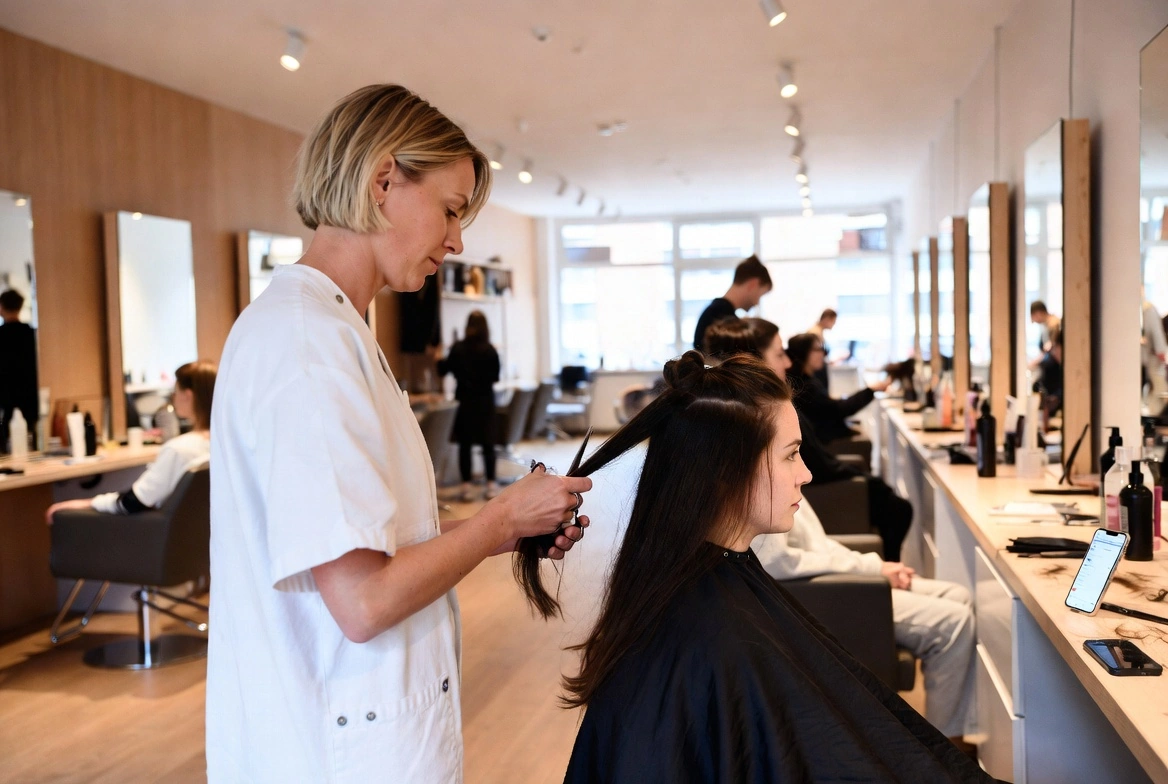
The hard thing about lost enquiries is that they are invisible. You see the customers who come in. You don't see the ones who wrote a message, got no answer within an hour, and booked with the salon two streets over instead.
Most enquiries to a salon fall into three groups:
The same ten questions over and over: price, available times, colour, parking, payment.
Messages outside opening hours, when no one is at the ready.
Customers who don't have Danish as their first language and are unsure about calling.
None of it requires your expertise. It just requires a quick, correct answer. And that is exactly where an AI chatbot is strong. Let us first agree on what it actually is.
What is an AI chatbot for a hair salon, really?
An AI chatbot is a digital helper that sits on your website, or in Messenger and Instagram, and answers customers instantly. Unlike the old press 1 for booking menus, a modern AI understands ordinary language and answers from your salon's own information: prices, opening hours, treatments, parking and which colour brands you use.
The most important thing is to understand what it is, and what it is not.
A good AI chatbot IS | An AI chatbot is NOT |
|---|---|
A fast first line for the repeated questions | A replacement for your advice in the chair |
Open 24 hours a day, also while you cut | A system that makes up prices you haven't given it |
Good at passing the customer on to booking or to you | A finished solution with no setup |
Able to answer in several languages | A robot that should stand alone with complaints |
How it helps in practice: 8 real conversations
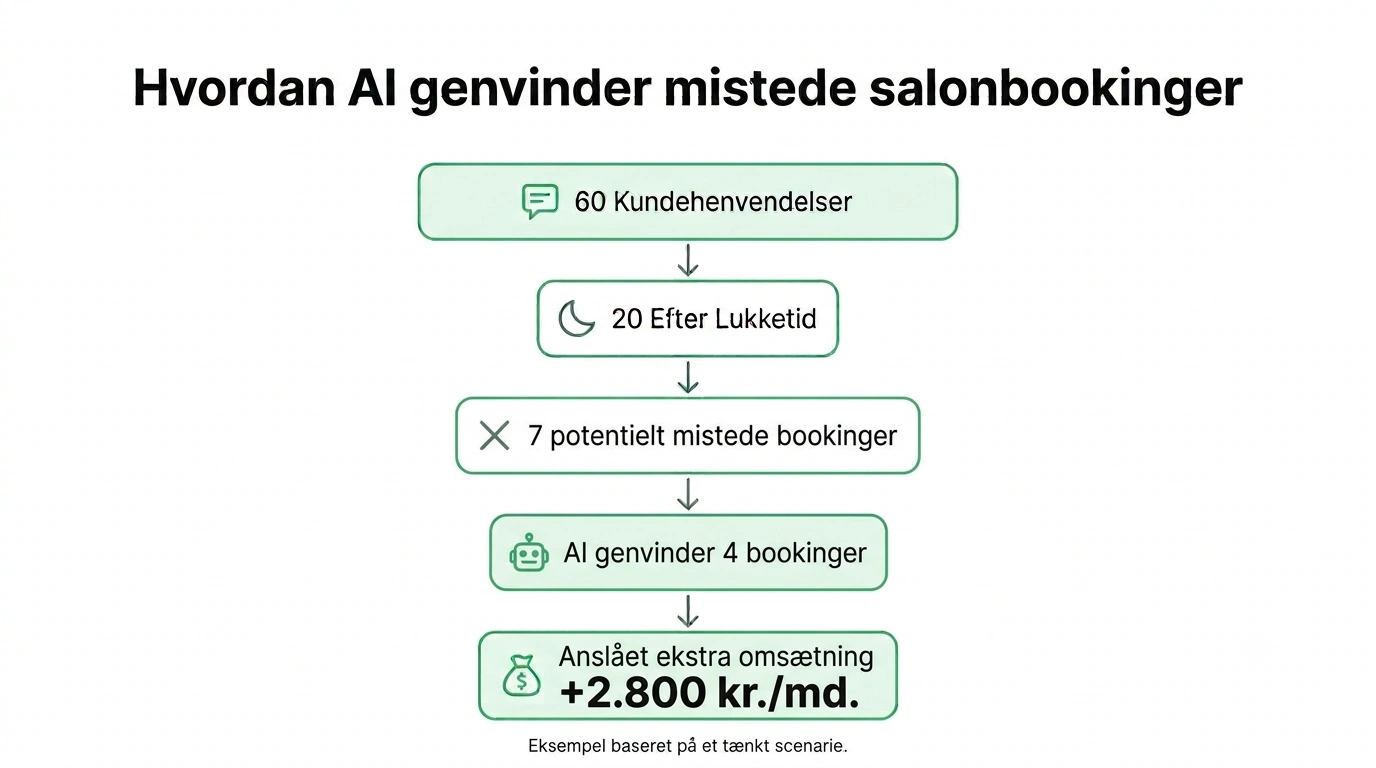
Theory is easy. Let us look at concrete conversations, as they could play out in a Danish salon. For each one we explain why the answer is good, because it is not trivial.
1. Price for cut and colour
Customer: Hi, what does a cut and colour cost for long hair?
Assistant: Hi. A cut and colour for long hair starts with us at 749 DKK. The final price depends on hair length and colour choice, so we give you the exact price after a short chat in the salon. Would you like to book a time?
Customer: Yes please, Friday if possible.
Assistant: Perfect. I'll send you the link to Friday's available times here. Can I help with anything else?
The assistant does not guess a fixed price. It gives the starting point, explains why the price varies, and takes the customer straight to booking.
2. Available times and opening hours
Customer: Are you open on Saturdays, and is there a time this week?
Assistant: Yes, we are open Saturday from 9 to 14. This week there is an opening Thursday at 14 and Friday at 10. Shall I reserve one of them for you?
The customer gets two concrete options right away. It is easier to say yes to a time than to be told to go looking.
3. Parking
Customer: Is there parking near the salon?
Assistant: Yes. There is two hours of free parking in the lot behind the building, and paid parking on the street out front. Most customers use the lot at the back.
A small, practical question that would otherwise interrupt you mid-cut is answered in two seconds.
4. Colour treatment and time
Customer: Do you do balayage, and how long does it take?
Assistant: Yes, we do balayage. It usually takes two to three hours and starts at 899 DKK depending on hair length. Would you like me to find an available time?
The customer gets both the time needed and the price level, so expectations are set before they sit down in the chair.
5. Danish-speaking customer
Customer: Hej, laver I striber i krøllet hår, og hvad koster det?
Assistant: Hej. Ja, vi laver striber i krøllet hår. Det tager typisk omkring to timer og starter ved 899 kr afhængigt af længde. Skal jeg finde en ledig tid til dig i denne uge?
The salon is Danish, and the assistant answers Danish customers fluently in Danish. You maintain your information in one place, and it meets each customer in their own language.
6. German tourist
Customer: Hallo, macht ihr auch Strähnchen? Was kostet ein Damenhaarschnitt?
Assistant: Hallo und willkommen. Ja, wir machen Strähnchen. Ein Damenhaarschnitt beginnt bei 449 kr, Strähnchen ab 699 kr, je nach Haarlänge. Möchten Sie einen Termin in dieser Woche?
Tourists often book at the last minute. An answer in German right away can be the difference that fills a quiet Tuesday.
7. Ukrainian customer
Customer: Доброго дня! Чи можна записатися на жіночу стрижку цього тижня? Я погано розмовляю данською.
Assistant: Доброго дня! Так, звичайно. Жіноча стрижка коштує від 449 крон. Є вільний час у четвер о 14:00 або п'ятницю о 10:00. Що вам зручніше?
A customer who is unsure of Danish often doesn't dare to call. A chat in their own language removes that barrier completely.
8. A complaint (and why the AI should step back)
Customer: I got a colour last week and it has turned out completely wrong. What do you do about it?
Assistant: I'm sorry to hear that, and I'd like one of our hairdressers to handle it personally. May I have your name and phone number, so we can call you today?
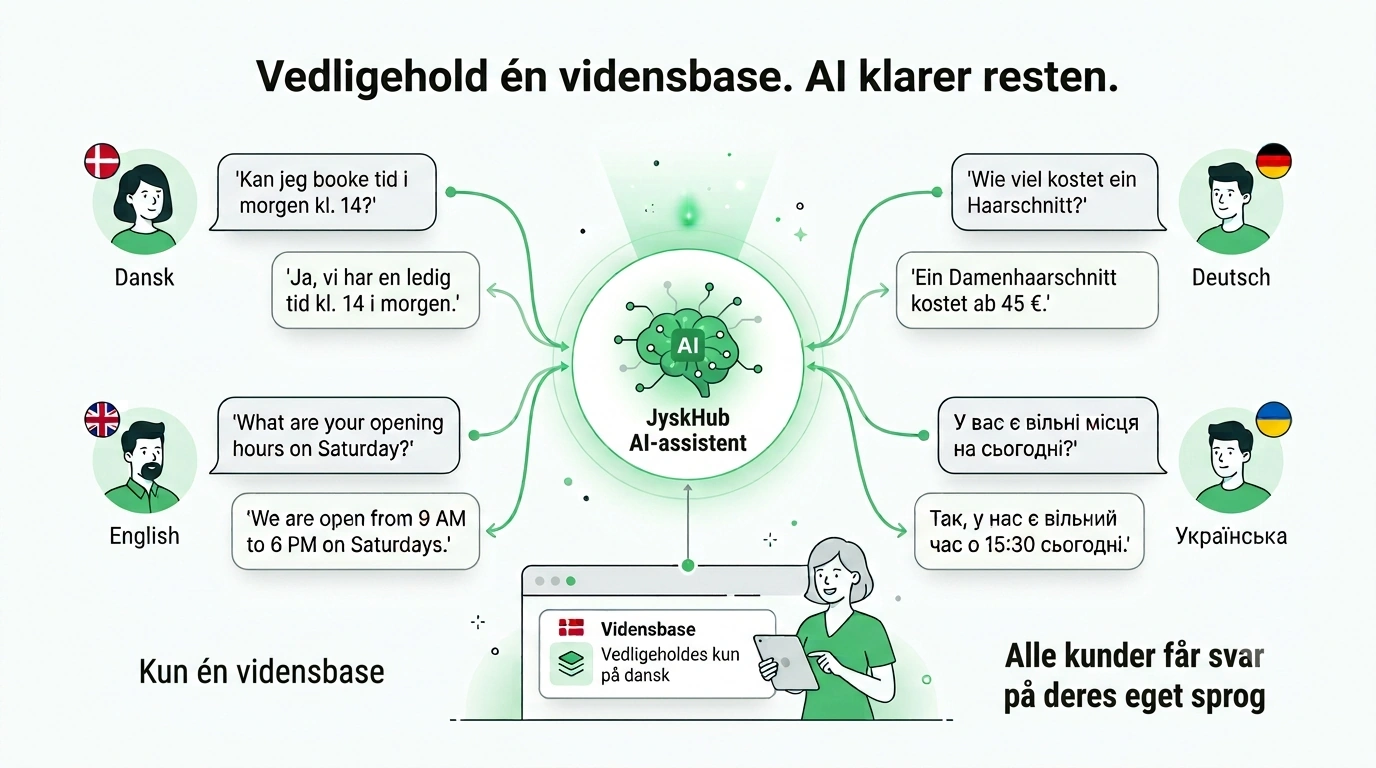
The assistant does not try to resolve a sensitive complaint itself. It shows empathy, fetches a human and captures the contact details. A bot that tries to handle complaints alone does more harm than good.
Bonus: a question it doesn't know the answer to
Customer: Do you use ammonia-free colour from the brand my allergy-prone daughter can tolerate?
Assistant: I can't answer that with certainty, because it concerns allergies. I'll pass your message on to one of our hairdressers, who knows the products. May I have your name and number, so they can get back to you today?
It honestly says I don't know instead of guessing about something to do with health. Honesty protects your salon's credibility.
Typical questions your salon gets every week
The conversations above are not random. Look at a normal week, and it is usually the same enquiries that fill it. The table shows what a chatbot can safely take itself, and what should always end with a human.
Question | Can AI answer alone? | When should a human step in? |
|---|---|---|
Price for cut, colour, highlights | Yes | Only for unusual requests |
Available times and booking | Yes | For rebooking of complex treatments |
Opening hours and parking | Yes | Rarely |
Kids' cuts and age rules | Yes | Rarely |
Payment and MobilePay | Yes | Rarely |
Allergies and hair health | No | Always |
Complaints about a treatment | No | Always |
A realistic calculation
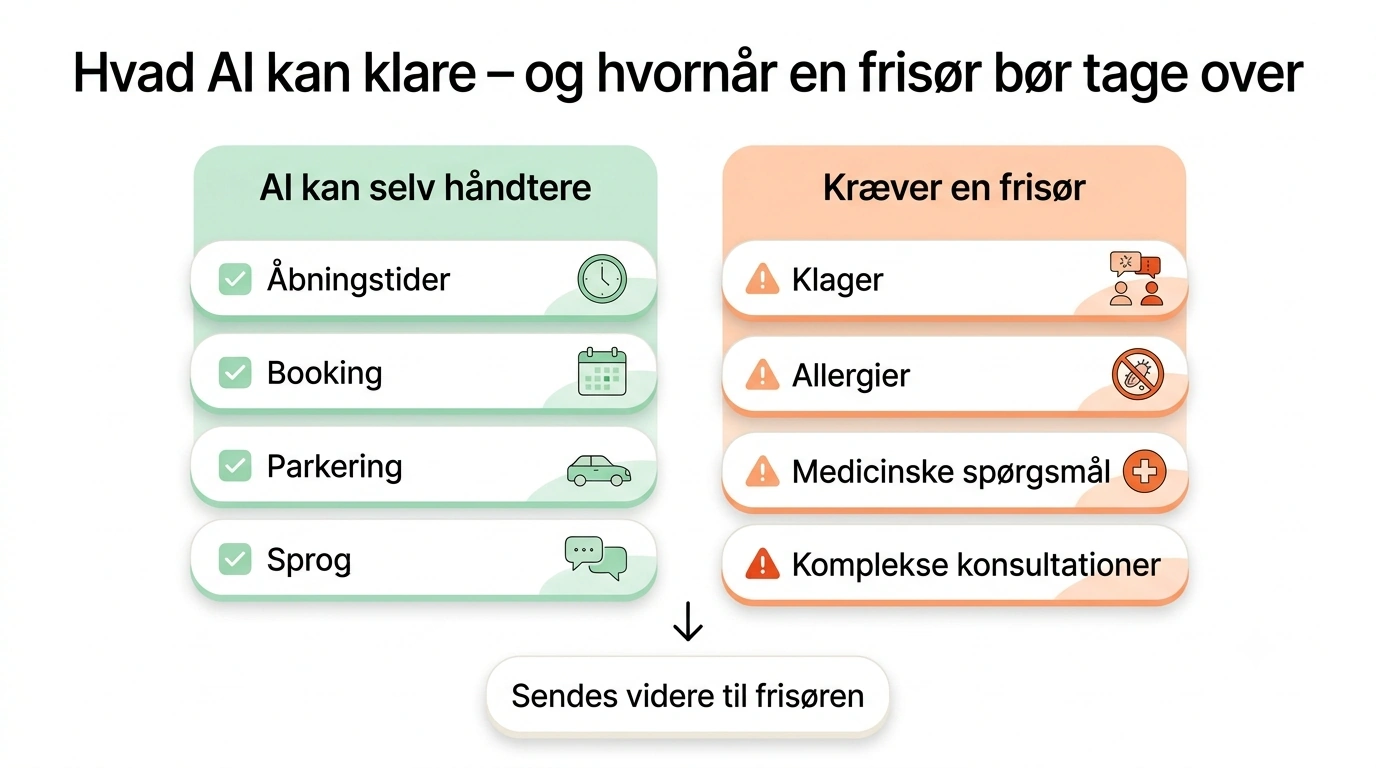
The big question, of course, is whether it pays off. Let us do the math on an imagined but realistic salon. The numbers here are assumptions, not statistics, so use your own when you work it out.
Example salon | Number |
|---|---|
Size | 3 chairs, owner plus 2 staff, in Aarhus |
Enquiries via web and social media per month | About 60 |
Of which outside opening hours | About 20 |
Assumed share lost because no one answers in time | 35 % (about 7 customers) |
If the assistant saves roughly half | 3 to 4 customers |
Average customer value (cut and colour) | 700 DKK |
Extra revenue per month | About 2,100 to 2,800 DKK |
The point is not the exact number. The point is that a website assistant often pays for itself on just a few saved bookings a month. If your enquiries are very few, the math looks different, and then you should think it over. It depends on your salon.
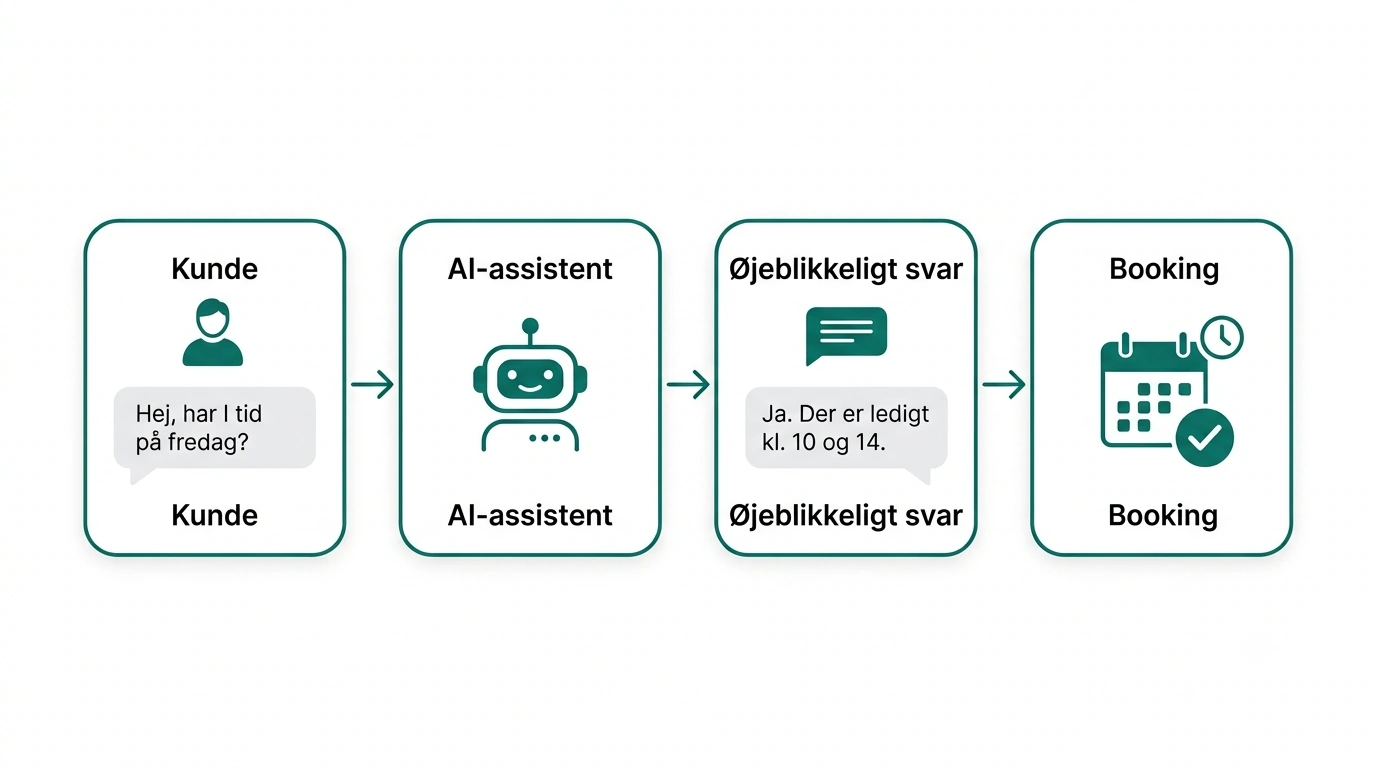
Three ways to use AI in a salon
Before you look at price, it is worth knowing that AI for hairdressers covers quite different things. They don't solve the same problem, so know the difference before you choose.
Type | What it does | Best for | Watch out for |
|---|---|---|---|
Booking bot | Shows available times and books | A fixed booking system | Weak on open-ended questions |
Phone AI | Answers the phone and talks | Lots of calls during work | Can feel impersonal with complaints |
Website assistant | Answers in chat from your knowledge | Prices, language, lead capture | Needs to be fed good information |
Social DM AI | Answers on Instagram and Messenger | Customers who mostly write on social media | Depends on the platform's rules |
Most salons get the most out of starting with a website assistant, because it captures prices, language and evening enquiries in one place. If almost all your contact is via Instagram, a social DM solution can make more sense.
GDPR and your customers' data
There is one topic most sales pages skim over, but which you should have a handle on: data. When a customer writes their name and phone number in a chat, you are processing personal data.
Three things to watch before you sign up:
Where is the data stored? Check where primary data is hosted, which subprocessors are used, and whether any transfers outside the EU/EEA happen under appropriate safeguards.
Can you delete it? You should be able to see and delete conversations and customer details.
Is there a data processing agreement? A serious provider offers one without fuss.
If you are unsure of the rules, the Danish DPA (Datatilsynet) has concrete guidance for small businesses at datatilsynet.dk. Read it, or ask your provider to point out how they help you comply.
The five most common mistakes
When salons end up disappointed with a chatbot, the cause is almost always one of these five. They are all easy to avoid.
An empty knowledge base. The assistant is only as good as the information you give it. Sparse information gives weak answers.
No handover to a human. Without a clear path to you, difficult conversations end in a dead end.
Prices that don't get updated. If your prices or opening hours change, the assistant must be updated the same day.
Hiding the chat away. Make it visible, but not intrusive in the middle of the screen.
Believing it can do everything. It should take the easy enquiries, not replace your expertise.
When an AI chatbot is not the right choice
Now we have seen where it helps. Let us be just as honest about the opposite, because it does not suit everyone. A chatbot solves a problem you don't have if:
Almost all your customers book by calling directly, and you have very few enquiries online.
You have a small, steady customer base where everything runs on personal contact.
You don't have the time or the desire to keep the information updated. Then the answers quickly become wrong.
And even when it fits, there is work involved. Expect an afternoon for setup, and reviewing conversations once a week for the first while, so you can fix what it answers awkwardly. A chatbot is not set and forget. It is a tool that gets better the better you look after it.
Honest about the drawbacks
An AI can misunderstand a question, it can answer stiffly if your knowledge base is thin, and it cannot sense mood the way a human can. That is why the right setup is to let it take the easy enquiries and always have an easy path over to you.
How to choose the right solution
If you have got this far and think it could make sense for your salon, the next step is to choose wisely. Spend a couple of minutes on this checklist and you'll avoid most of the frustrations.
Criterion | What to ask about | Why it matters |
|---|---|---|
Language support | Does it answer the customer in their own language? | Captures international customers and tourists |
GDPR and data processing | Where is data hosted? Is there a data processing agreement? | Clearer documentation, less risk |
Knowledge base | Can you edit the answers yourself? | You can update prices without help |
WordPress | Is there a plugin or simple code? | Most Danish salon sites run WordPress |
Shopify and Wix | Are they supported? | If you sell products, it matters |
Lead capture | Does it save name and number? | So you don't lose evening enquiries |
Human handover | Can it pass the conversation on to you? | Complaints and hard cases need a human |
Analytics | Can you see what customers ask about? | You get to know your own customer base better |
Installation | How long, and who does it? | Decides whether you actually get going |
One good tip: always ask to see the assistant answer your own questions before you decide. A demo on your real prices and treatments says more than any sales talk.
Where JyskHub fits in
There are several good tools on the Danish market, and the right choice depends on your salon. JyskHub is one of the options, and we mention it here because it is built on exactly the principles we have been through.
In short, it is an assistant that sits on your website as a small chat. It uses your own knowledge base as its primary source, answers customers around the clock and in their own language, captures name and number, and hands the conversation over to you when something needs a human. Primary service data is hosted on European infrastructure where possible; documented subprocessors may process limited technical data elsewhere. It works with WordPress, Shopify, Wix and custom sites. JyskHub has a free plan with no expiration date and no payment card required. Paid plans start at DKK 299 per month.
It is not the only choice, and it is not the answer for everyone. See it as one example of how the checklist above can look in practice, and do compare it with others before you decide.
Pros | Cons |
|---|---|
Answers customers 24/7, also outside opening hours | Requires setup and ongoing upkeep |
Captures leads you would otherwise miss | Is only as good as your knowledge base |
Answers in the customer's own language | Can misunderstand and answer stiffly |
Frees up time from the repeated questions | Unsuited to complaints and professional advice |
Cheap compared with an extra employee | Makes little sense with very few online enquiries |
Conclusion
An AI chatbot doesn't solve everything, and it is not right for every salon. But for most salons that lose enquiries in the evening, spend too much time on the same questions, or lose international customers over language, it is a cheap and practical tool.
Start small. Gather your information, choose a solution from the checklist, test it on your own questions, and make sure it can always pass the customer on to you. Then it takes the tedious part, and you keep what you are good at: the customer in the chair.
FAQ
What is an AI chatbot for hairdressers?
A digital helper on your website or social media that answers customers instantly from your salon's own information and passes them on to booking or to you.
Can a chatbot book appointments directly?
Yes, if it is connected to your booking system. Otherwise it sends the customer on to your booking page with a direct link.
Does it answer in languages other than Danish?
Yes. A good assistant answers each customer in their own language, while you only maintain your information in Danish.
What if it doesn't know the answer?
Then it should say so honestly and fetch a human instead of guessing. That is an important sign of quality.
How long does it take to get started?
Often an afternoon. Most of the time goes into gathering your prices, treatments and typical questions.
Does it work with WordPress, Shopify and Wix?
Yes, most solutions work with all three as well as custom websites.
What does an AI chatbot for a salon cost?
From a few hundred kroner a month for a simple website assistant up to several thousand for a full package with phone AI and booking integration. Always ask what is included.
Is it hard to use if I'm not technical?
No. Setup requires no coding, and you can usually edit the information yourself afterwards.
What about my customers' personal data and GDPR?
Choose a solution with clear information about hosting, subprocessors, conversation deletion and a data processing agreement.
Does it replace my staff?
No. It takes the easy, repeated enquiries, so you and your staff get more time for the customer in the chair.
Does it require maintenance?
Yes. You need to update prices and opening hours when they change, and ideally review conversations once a week for the first while.